
The Uganda Gazette
The official Government publication for Notices, declarations, Bills, Acts, Statutory Instruments and Legal Notices. Published weekly by UPPC and open to the general public.

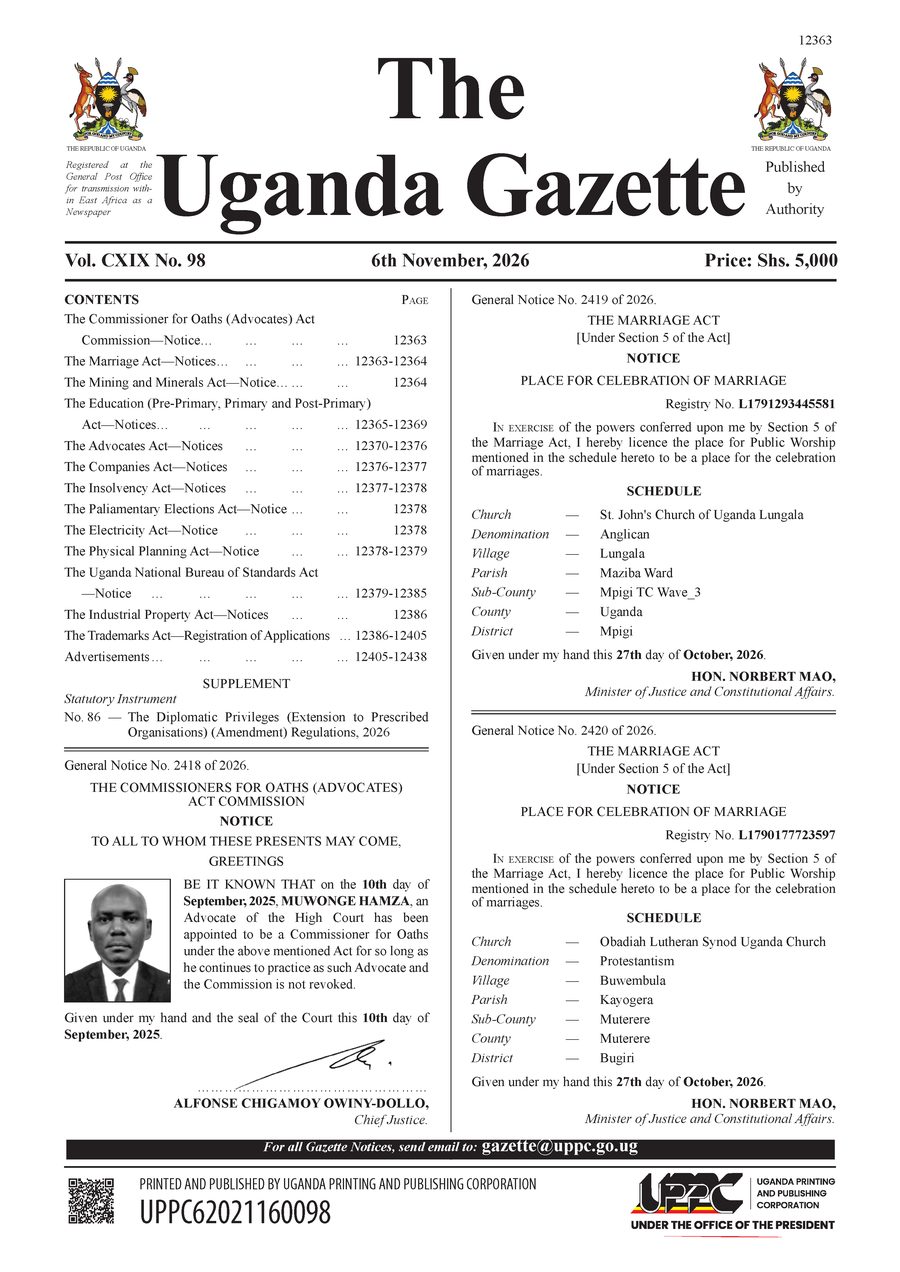
Government's official voice to the public
The Uganda Gazette is the official Government publication in which important Government communications to the public are published. Once something appears in the Gazette, the public is taken to be duly informed about it.
It is a weekly publication that is open and accessible to the general public, and includes every Supplement and Gazette Extraordinary.
Defines the Gazette as the Uganda Gazette, including any Supplement of that Gazette.
Defines a Gazette as the Uganda Gazette, including any supplement or Gazette Extraordinary.
Requires Acts of Parliament to be published in the Gazette.
The main target audience
Benefits of the Uganda Gazette
Everything, every week
Weekly Gazettes plus all supplements: Bills, Legal Notices, Acts and other Government bulletins.
Official and authentic
Anything published in the Gazette is taken as public knowledge. It is the authentic legal record.
Stay current on the law
A weekly update on new and revised laws of Uganda passed by Parliament.
Business opportunities
Notices from URSB, the Ministry of Lands, the Ministry of Energy, professional bodies and Local Governments, including ordinances and bye-laws.
Free delivery
Subscribers receive their copy delivered free at their doorstep.
Built to keep
A long shelf life for record keeping and future reference.
- A copy of every weekly Uganda Gazette
- All supplements published in it
- Free delivery to your doorstep
Subscribe or gazette a notice
Browse the e-Gazette →A century of the Uganda Gazette
From the Official Gazette of the Uganda Protectorate to today's weekly edition, the Gazette has recorded the official life of the nation. Click any cover to see it bigger.
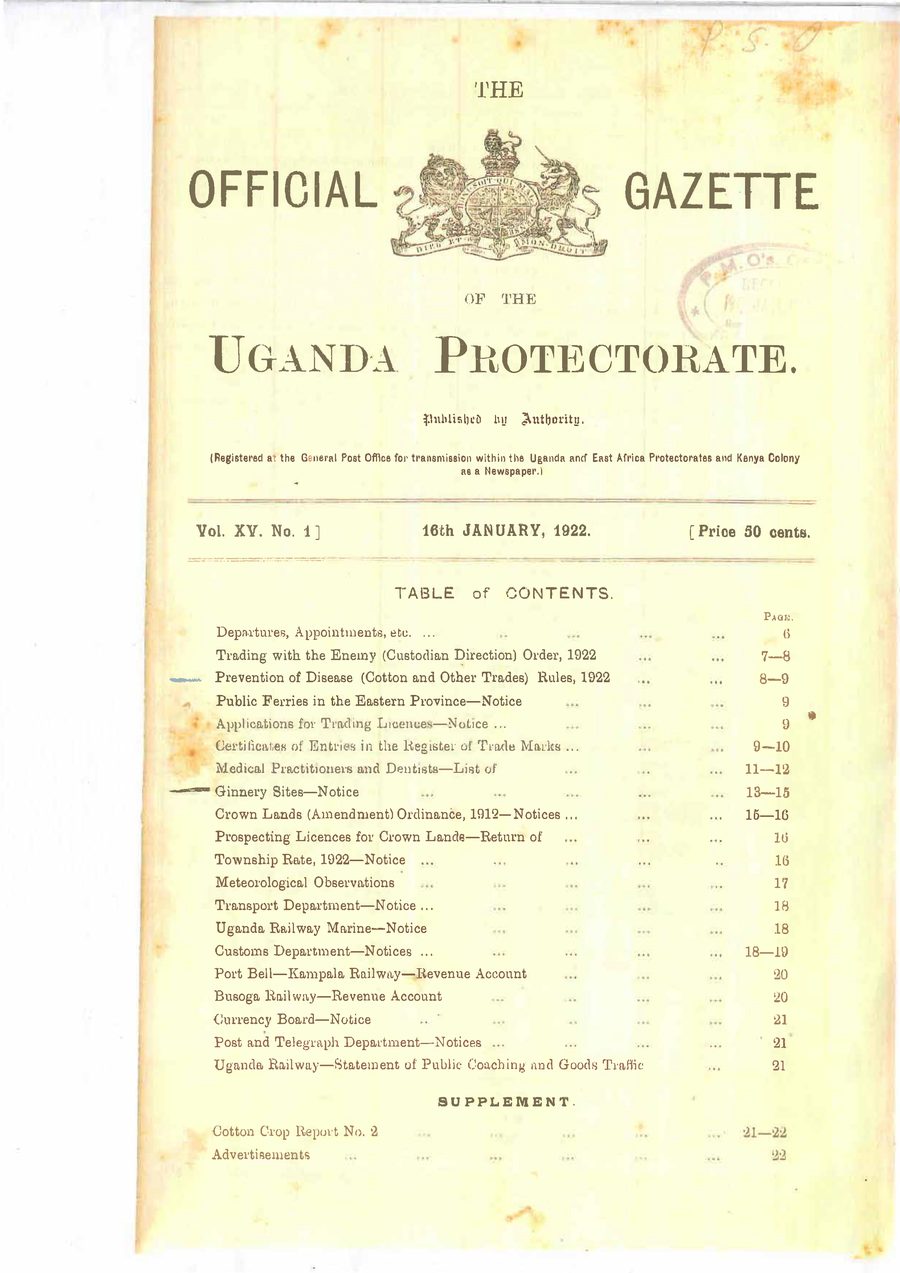
Uganda Protectorate
Vol. XV, No. 1. Published as the Official Gazette of the Uganda Protectorate. Price 50 cents.
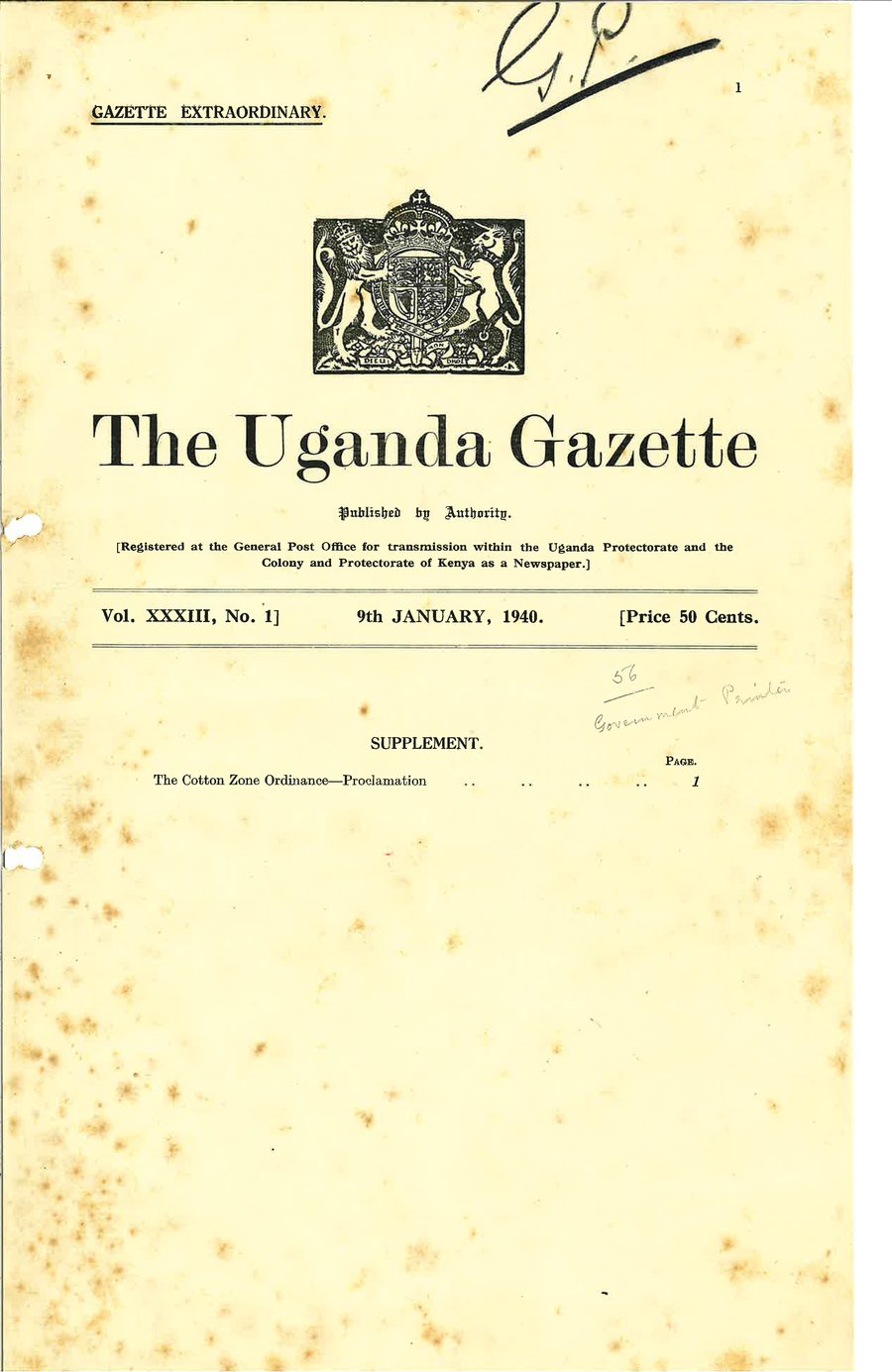
Gazette Extraordinary
Vol. XXXIII, No. 1. Now titled The Uganda Gazette, with a supplement on the Cotton Zone Ordinance.
The classic masthead
Vol. XLI, No. 2. The familiar blackletter title, with contents and notices in two columns.
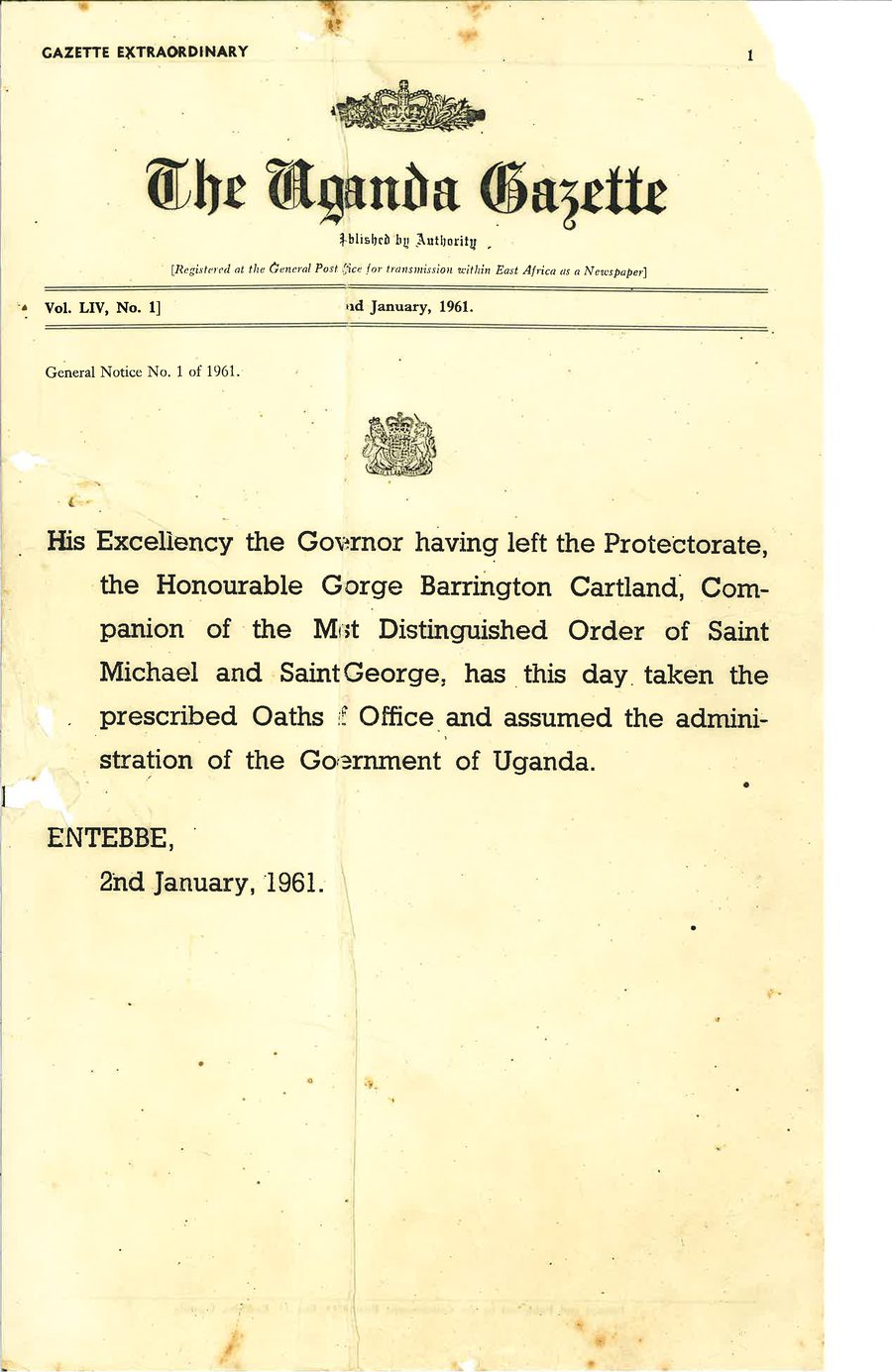
On the eve of independence
Vol. LIV, No. 1. A Gazette Extraordinary issued at Entebbe, the year before independence.
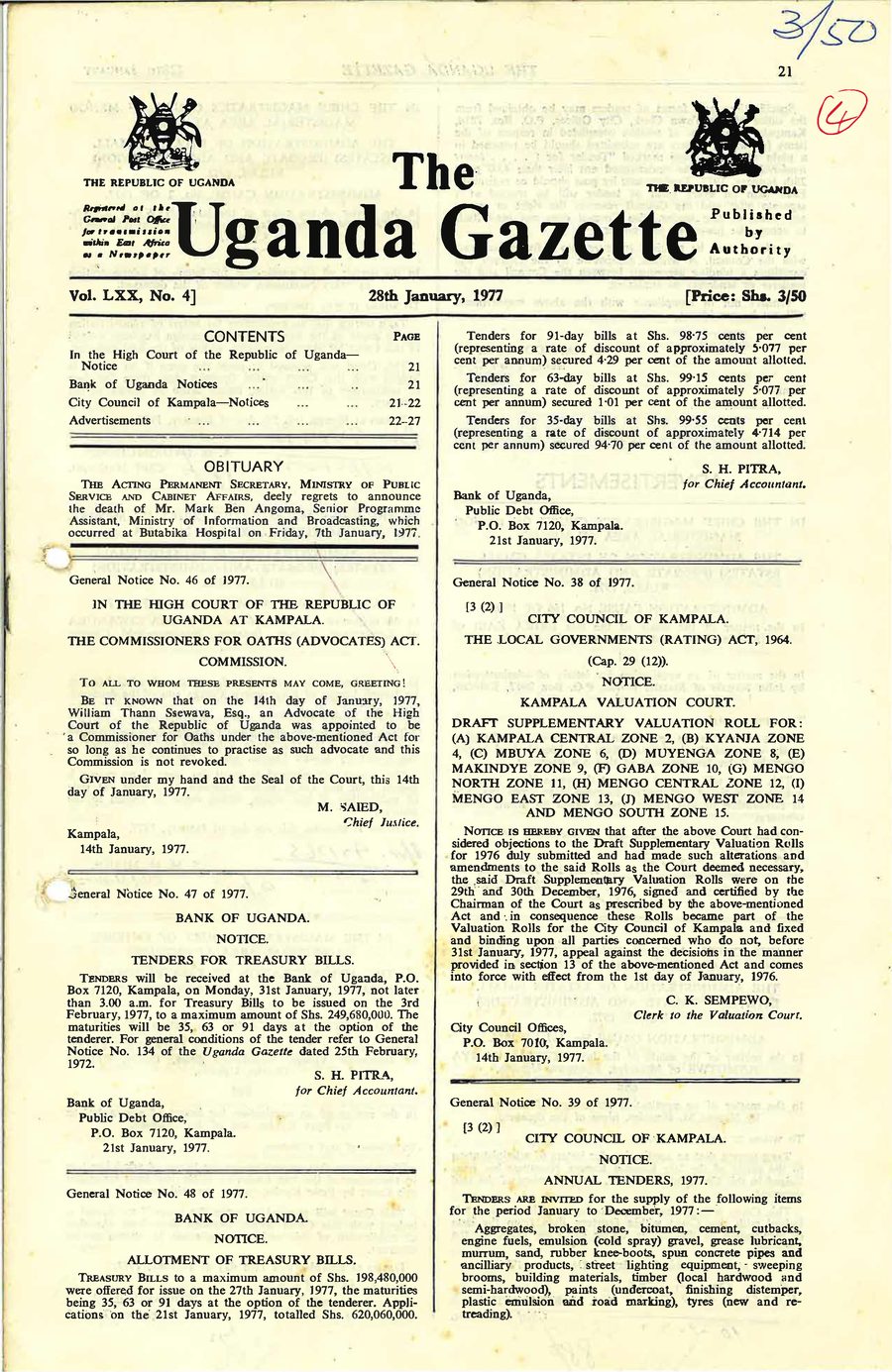
The Republic of Uganda
Vol. LXX, No. 4. The national coat of arms now frames the masthead. Price Shs. 3/50.
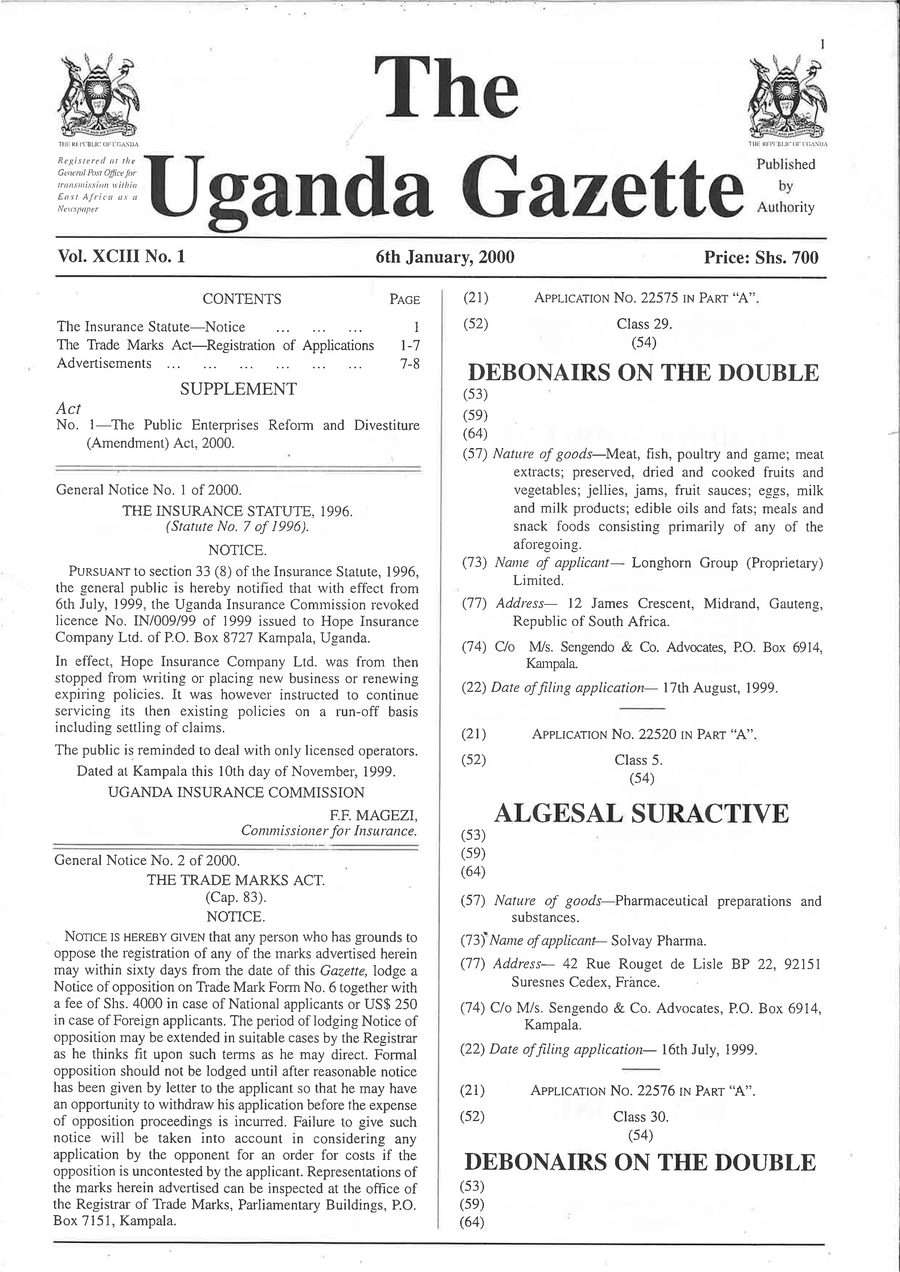
A new millennium
Vol. XCIII, No. 1. The modern layout that is still in use today. Price Shs. 700.
Today
Vol. CXIX. Printed and published by UPPC, and now free to read online.
Frequently asked questions
Who publishes the Uganda Gazette and why?
The Uganda Gazette is published by the Uganda Printing and Publishing Corporation (UPPC), which is established under Section 2 of the Uganda Printing and Publishing Corporation Act Cap. 215.
Section 2 of Cap. 215 establishes the Corporation as a body corporate with perpetual succession. The functions of the Uganda Printing and Publishing Corporation are prescribed by Section 5.
The main function of the Corporation is to provide printing and publishing services to the Government, Ministries, Departments, parastatal bodies and to private individuals and organizations. This is provided for in Section 5(1).
Under Section 5(2) the Minister may, after approval by Cabinet, by statutory instrument direct any ministry or department to have its printing and publishing work done by the Corporation.
Additionally, the detailed functions of the Corporation are specified in Section 5(3), which reads as follows:
“(3) Without prejudice to the generality of subsection (1), the corporation may do the following:
- Print and publish all Government legislation and documents;
- Act as an in-service school to train its own and other organizations’ apprentice printers;
- Act as the chief adviser to the Government on all printing and publishing matters;
- Provide printing services to parastatals, private organizations and individuals;
- Provide stationery, such as envelopes, desk calendars, letter heads, visiting cards, file folders or other stationery for office use;
- Produce posters and other forms of advertising materials;
- Produce paper bags, paper boxes and other paper packing containers;
- Provide technical drawings and architectural plans;
- Publish books, booklets or other publications which enhance the culture, welfare and unity of Uganda;
- Print both textbooks and exercise books or any other books for general reading or use;
- Carry out binding services on books, magazines or other documents;
- Provide business and accounting stationery, such as receipt forms, cash books and ledger books;
- Undertake security printing works as may be determined by the Minister in consultation with the board;
- Carry out any other activity that may be carried out by a printing and publishing institution.”
What are the consequences of Gazetting?
Where anything is published in the Gazette, it can be taken that the public is duly informed about the matter contained in the Gazette. In more recent times, in cases where the Government desires to ensure that by all means the public are duly informed, certain laws provide that in addition to Gazette publication, the matter concerned be published in the media.
The other aspect is that if there is a requirement for Gazette publication under any enactment and the requirement is not complied with, it means the action under the requirement is not fully performed and it will therefore not have the intended legal effect. For example, if an Act is not published in the Gazette as required by Article 91(8) of the Constitution, the Act cannot be enforced as law.
History of the Uganda Gazette
The history of the Uganda Gazette can be traced back to the time of the missionaries in the 1880s. When they arrived in Uganda, the missionaries set up churches and schools. This exposed some Ugandans to the culture of reading and writing.
After the missionaries, the British colonialists came into Uganda and they also introduced their own education system. All these were exposing Ugandans to new ideas. When the Second World War erupted, the British mobilized a number of Ugandans and took them to fight on their side in Europe.
By the end of the war these Ugandans had been exposed to so many ideologies, and when they came back with these revolutionary ideas they started publishing newspapers like “Gambuzze”, “Munyonyozzi” and “Tula Nkunyonyole.” Through these newspapers, revolutionary messages against the British colonialists were disseminated to the public.
In 1945, when country-wide riots against British rule erupted, the British blamed the newspapers for fueling the riots and these papers were banned.
As a result, the British set up their own newspaper called the “Uganda Gazette.” All this took place during the 1950s.
Other newspapers were later published, like the Uganda Argus. Today, there are many newspapers in Uganda, e.g. the New Vision, the Daily Monitor, the Observer, etc.
The Uganda Gazette was retained as the official Government legal bulletin despite having other newspapers in circulation.